
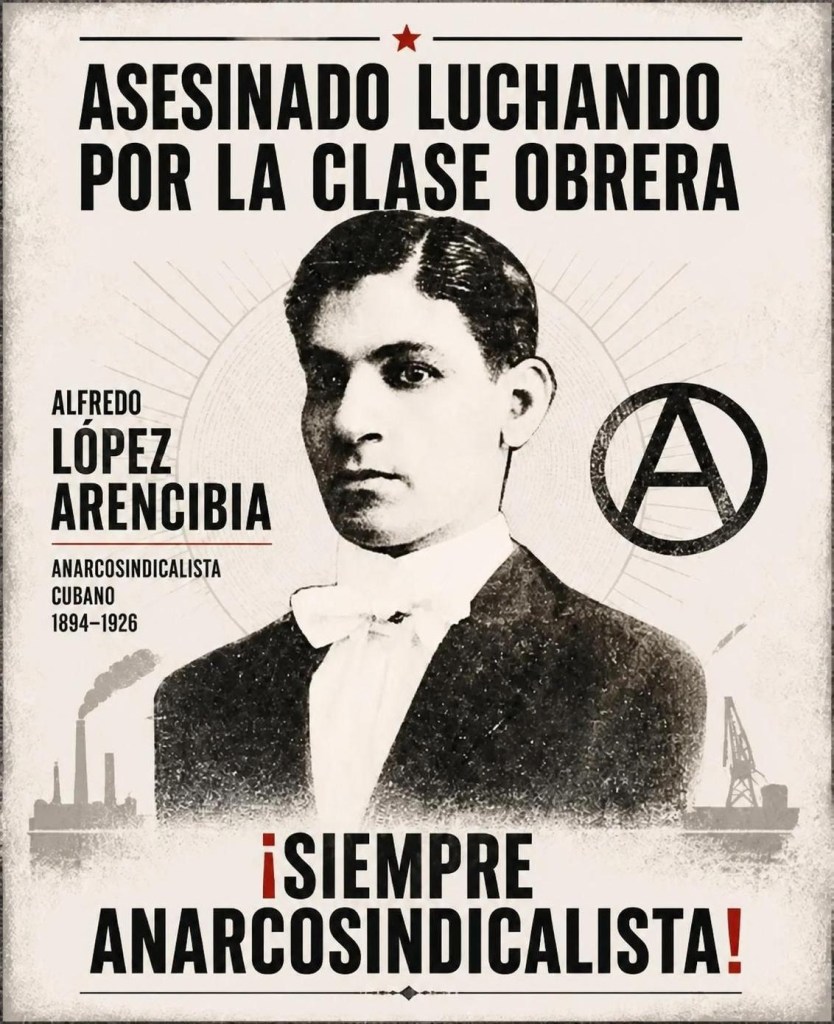
July 20, 2026 — One hundred years after the assassination of anarcho-syndicalist Alfredo López Arencibia, a look at how a heroic figure of the Cuban working class was reclaimed
On this July 20, 2026, we mark the centennial of Alfredo López Arencibia’s assassination. This date marks not only the violent end of a man, but also the end of a glorious era for the Cuban labor movement.
A figure of rare consistency, López was the catalyst for a transformation of Cuban working life; he was able to combine libertarian ethics—based on autonomy and direct action—with organized union struggles, forever changing the island’s social dynamics.
In the early 1920s, the Cuban labor movement was fragmented into mutual-aid societies and isolated corporate banners. López worked to bring these workers’ organizations together. While he was the architect of the Havana Workers’ Federation (FOH) (1921), his major achievement was the founding of the National Workers’ Confederation of Cuba (CNOC) in 1925.
The rise of Gerardo Machado to power, the “little Mussolini” of the Caribbean, simultaneously created a climate of terror aimed at undermining any form of organized dissent. With his ability to mobilize the masses in Havana, López became the main target.
His assassination, carried out within the walls of the Castillo de Atarés in July 1926, was an act of political, social, and symbolic violence. The regime did not only want to eliminate a leader; it wanted to destroy the symbol of mobilization and working-class organization that threatened Machado’s rule. That is why his body was hidden for several years after his death.
His companions’ search for his body helped crystallize the myth of a working-class organizer who, even in death, continued to be the voice of the voiceless.
A domesticated memory
Alfredo López Arencibia’s figure is one of the most emblematic examples of the rewriting of history that characterized the ideological legitimation process of the Castro regime and of Cuban Marxism after 1959.
Under the control of the PCC and Cuban Marxism, López is a domesticated myth: the silent emblem of unionism subordinated to the directives of political power; a revolutionary from whom all reference to anarchism was stripped in order to make him acceptable to the State’s dogma—a “hero of the homeland,” a forerunner of proletarian unity.*
This is the narrative repeated in school textbooks and at congresses of the Central de Trabajadores de Cuba (CTC), the single union center, the conveyor belt of power that embodies exactly the opposite of what López proposed.
It could not be otherwise, because acknowledging the truth about López would mean giving legitimacy to a non-authoritarian, anti-centralist socialist alternative. This would undermine the stability of a regime built on the monopoly of political and union power by a single party.
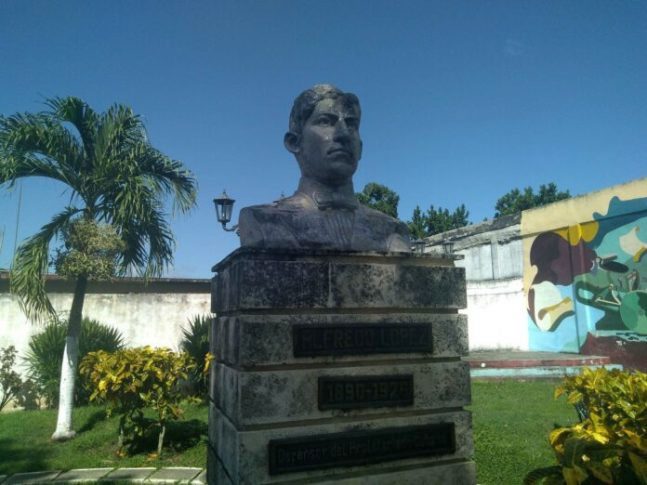
This censorship of memory will, of course, not prevent Cubans from knowing their own history. As with several independent collectives, libertarian activists at the Taller Libertario Alfredo López have been trying for years to make known the true political identity of this major figure of Cuban anarcho-syndicalism. And that is what they did, in fact, during the unveiling of a commemorative bust of Alfredo López in Sagua la Grande, in the province of Villa Clara, in front of the party’s top officials.
A coordination of solidarity
This article follows our call “Toward a coordination of solidarity with Libertarian Cuba,” launched last week. We thus reaffirm our commitment to making known the history of the Cuban anarchist labor movement.
Moreover, since the publication of our call, we have been accused by some people of playing into American imperialism. Let us recall that anarchism and anarcho-syndicalism have a clear anti-imperialist position—summarized in essential terms by several authors who have already laid out the main ideas and history (Sam Dolgoff, Lucien van der Walt, etc.).**
In short, the anti-imperialist struggle must not be accompanied by the formation of a state, however decolonized it may be, and it is impossible to call oneself anarchist while also supporting the embargo and U.S. imperialist political interference in Cuba. Our political vision involves continuing to develop the revolutionary aspects initially proposed by the anarcho-syndicalist labor movement, before the sabotage carried out by the Cuban Communist Party.
We find that, in most of today’s societies, anarchist perspectives are ignored, set aside, and discredited. That is why debates so often boil down to a false campist dichotomy: either one is an imperialist reactionary, or one is aligned with the Cuban communist regime. Let us not forget that revolutions are made by workers—not by the party—and that a social revolution remains necessary in Cuba, as elsewhere!
—
*For “Cuban Stalinists,” López may indeed be a sympathetic figure when one considers that, in the desire to unite the working class, he allowed them to take their place in the CNOC… thereby giving them the opportunity to take over the organization.
** References
– Towards a History of Anarchist Anti‑Imperialism – Lucien van der Walt
– Third World Nationalism and the State – Sam Dolgoff
– African Anarchism – Sam Mbah et I.E. Igariwey, See Sharp Press


Votre commentaire